

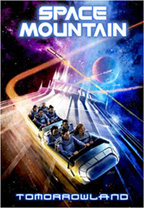
Two year earlier, in January 1975 Disney's very first Space Mountain opened at the Magic Kingdom
in Walt Disney World and of course an American astronaut was in attendance. The first official ride
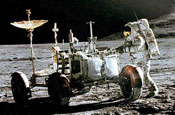
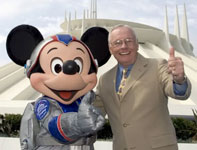
on Space Mountain was taken by astronaut James Irwin, the 8th person to walk on the Moon. Colonel Irwin
was the pilot of the Lunar Module on Apollo 15 (which landed on the Moon in July 1971). He also became the
firsr automobile passenger on the moon when he road aboard the Lunar Roving Vehicle. One of the 19

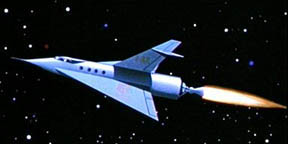


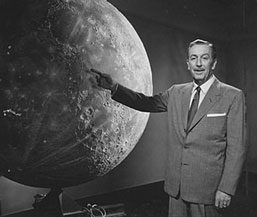
Walt Disney's long relationship with NASA and his interest in space travel goes back
to a 3-part "science-factual" television series. The programs (part of the Disneyland TV
Mars and Beyond. Walt and his studio worked closely with prominent German scientist Wernher
Von Braun, who served as technical advisor on the programs. In a real sense, Walt helped Von
Braun sell Americans on space during a time when traveling to the moon was purely science
fiction. (Von Braun went on to oversee most of the achievements of the U.S. space program -
including the historic 1969 moon landing - until his death in 1977.) The popularity of the TV
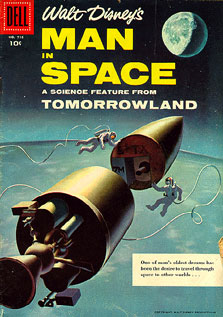
specials even led to a series of comic books published by Dell.
It was Disney animator Ward Kimball (who was senior producer of the series) who
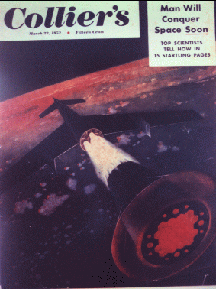
actually took notice of Von Braun and other scientists through articles in Collier's
magazine. Along with Walt, they used the new medium of television to
illustrate how man might fly to the moon and beyond.
These 3 successful TV shows were just the beginning of Disney's interest in space travel and a futuristic world of Tomorrow. In
fact they can be seen today on the 2004 DVD release Walt Disney Treasures - Tomorrowland: Disney in Space and Beyond.
space artists) probably did more than any other medium to suggest that space travel was possible. At its highest
point, Collier's attained a circulation of approximately 4 million very excited readers. But Von Braun realized that another
medium called television had the potential to influence even a greater number of people.
The 29 missions that the United States and the Soviet Union sent to the moon between 1959 and
1976 are each designated on the moon sphere in the Planetary Plaza of Epcot's Mission: SPACE.

"Now, when we opened Disneyland, outer space was Buck Rogers.
I did put in a trip to the moon .... and, of course, we were going up to the
moon long before Sputnik. And since then has come Sputnik and then has
come our great program in outer space. So I had to tear down my
Tomorrowland that I built 11 years ago and rebuild it to keep pace."
- Walt Disney



 | ||||||
Did you know that Walt Disney helped the U.S. military
imagine the experience and reality of space travel?


TO INFINITY ...
... AND BEYOND!
| ||||

| ||||

THIS SITE MADE IN THE USA
DISNEY
&
SPACE
TRAVEL
| ||||||
Ward Kimball received a phone call from Wernher Von Braun in 1969. "When we landed on the moon, he called me
long distance and said, 'Well, Ward, they're following our script!' Actually, all his calculations were right on the button."

| ||||||
The 3 episodes sold many Americans on the idea of space flight, including a young teenage boy
from Iowa named Stephen Bales. Bales was inspired to become an aeronautical engineer
by one of these very episodes.
"It was about 1956 when I saw that Disney program," Bales remembers. "I must have been 13.
It really wasn't that darned far off, either. It had some exploratory missions. At the time, one of
the big unknowns was what the back side of the moon looked like. So they were checking out the back side and
they were doing radar mapping of the moon. And then they had another flight and actually did the landing. I was watching all of that, and it made a big impression on me. It was outstanding."
Bales went on to play an important role during the Apollo 11 moon landing in 1969 as a member of mission control. "It was the Walt Disney cartoon come to life."
Even U.S. President Dwight Eisenhower took notice of Disney's Man in Space. He requested a copy to impress the military top brass who were dismissing space travel as "Buck Rogers science-fiction."
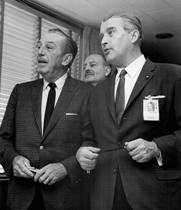
In April 1965, 10 years after Man in Space first aired, Von Braun invited Disney and others involved in the 1950s episodes to tour the Marshall Space Flight Center in Huntsville, Alabama. He hoped that Disney's further involvement in the space program would bring about greater public interest in the future. Today there is a display about Disney's 1950s television shows
and his 1965 Alabama visit at the U.S. Space & Rocket Center in Huntsville.
from the original seven Project Mercury space travelers (and the widow of the seventh) attended the grand
opening of Disneyland's Space Mountain in May 1977.
Neil Armstrong, the very first human to step foot on the moon, took part in the reopening
of Disneyland's Space Mountain in July 2005. An astronaut, aviator, and test pilot, Armstrong
was commander of Apollo 11 in July 1969. His historic moon landing was televised live all over the
world including Disneyland on July 20, 1969. Armstrong also flew aboard Gemini 8 in 1966 as the
command pilot. Not known for publicity, Armstrong's Disneyland appearance was a rare and
unique opportunity for Disney fans to see a true American hero up-close.
Another American astronaut who appeared many times at Disney theme parks was Wally Schirra.
Over the years Schirra made appearances for such events as the 2003 debut of Epcot's Mission: SPACE and the unveiling
of Disneyland's new Tomorrowland in 1998. In 2003 he even appeared on ABC-TV's broadcast of the 20th Annual Walt
Disney World Christmas Day Parade. The only person to fly in all of America's first three space programs (Mercury, Gemini
and Apollo), Schirra flew aboard Apollo 7, the first manned mission in the Apollo program. Commander Wally Schirra wore
a Mickey Mouse wristwatch during that October 1968 flight!
American astronauts are not the only space travelers to be welcomed at a Disney theme park. In
October 1969, Russian cosmonauts Major General Georgiy Beregovoy of the Russian Air Force and
civilian scientist Konstantin Feoktistov visited Disneyland (as part of their two-week tour of the U.S.)
At a ceremony held in front of Flight to the Moon, Mickey Mouse and Pluto (dressed in space helmets
& space suits) presented the Russian space travelers with Mickey Mouse watches and hats!
Fellow Apollo 11 astronaut, Buzz Aldrin (the second man to walk on the moon) has a connection with Disney as
well. Like other space travelers, he too was present at the launch of Epcot's Mission: SPACE in 2003 (he even shot a comercial
for Disney promoting the attraction). But Aldrin can list 'voice actor' to his list of accomplishments - he voiced himself in the
Recess episode "Space Cadet." His most important tie-in to Disney ... Aldrin is the inspiration for the Pixar character Buzz
Lightyear (of Toy Story fame). In fact fictional spaceman Buzz Lightyear made a real-life trip into space aboard space shuttle
Discovery in 2008 (as part of an educational program by NASA & Disney).
Modern-day space shuttle astronauts (such as Story Musgrave and teacher-turned-astronaut
Barbara Morgan) have been spotted in and above Walt Disney World in Florida. Due to WDW's
close proximity to Cape Canaveral, it isn't uncommon for guests to spot a launched space
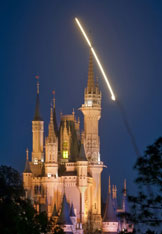
shuttle soaring across the Central Florida sky. In March 2009, Disney World guests and Cast
Members paused to catch a glimpse of space shuttle Discovery as it headed for space. In
September 2007, Disney World honored the crew of the NASA space shuttle Endeavour mission
and the achievement of mission specialist Barbara Morgan. Epcot and Magic Kingdom held
ceremonies that day (which included a dedication at Mission: SPACE) and allowed school
children to interact with the Endeavour astronauts!
Back in the day when Disney's Hollywood Studios was known as Disney-MGM, Tom Hanks' HBO series
From the Earth to the Moon was in production at the theme park. The 13-part drama was partly shot
in two soundstages throughout 1997. During downtime, Disney gave tours of the soundstages to
park guests.
Past and present theme park attractions like Rocket to the Moon, Mission to Mars, Flying Saucers,
StarJets, Space Mountain, The American Space Experience, Space Station X-1, Star Tours, and
Mission: SPACE have brought NASA astronauts and Disney fans together and reinforced the public's
interest in space travel and a world of tomorrow.
WALL-E (2008) - about a robot named WALL-E who is designed to clean up a waste-covered Earth far in the
future. Produced by Pixar Animation Studios and directed by Andrew Stanton, it was the most complex Pixar
production since Monsters, Inc.
"A vista into a world of wondrous ideas, signifying man's achievements .... A step into the future with
predictions of constructive things to come. Tomorrow offers new frontiers in science, adventure, and ideals,
the atomic age, the challenge of outer space and the hope for a peaceful and unified world."
-Walt Disney's Tomorrowland Dedication Speech

| ||||||
The first episode Man in Space originally aired March 9, 1955. Running at about
51 minutes, it was mostly narrated by actor Dick Tufield (who ironically would later
be best known as the voice of the Robot on the TV series Lost in Space). Also joining
in was Kimball and such famed scientists as Dr. Willy Ley, Dr. Heinz Haber, and of
course Dr. Wernher Von Braun. With a combination of documentary footage and
animation, the show took a lighthearted look at rocket history, satellites, and what
spacemen would have to face traveling in a rocket. Man in Space was nominated for
an Academy Award for Best Documentary Short.
The second episode Man and the Moon, which first aired on December 28, 1955, was narrated by Paul Frees
(the voice of Disney's Professor Ludwig Von Drake). A humorous look at Man's fascination with the Moon, the
segment featured the Moon's usage in everything from William Shakespeare and children's nursery rhymes to
lunar superstitions and scientific research. Once again Ward Kimball made an appearance as did Dr. Wernher
Von Braun, who discussed plans for a trip around the moon. The episode ended with a live action simulation
from inside and outside the manned Lunar Reconn Ship RM-1.
Mars and Beyond, the final segment, originally aired December 4, 1957. Once again narrated by Paul Frees,
the episode discussed the possibility of life on other planets, especially Mars. It began with a unique
introduction by Walt Disney and his robot friend Garco, who provided a brief overview. Unlike the other 2
episodes, Mars and Beyond adopted a more serious tone as it profiled each of the planets in the solar system,
from the perspective of what would happen to a man on them. Filled with striking, inventive and decidedly
atypical Disney animation, the show wrapped up with a trip to Mars. The mission showed six MarsShips,
ultimately reaching 100,000 MPH, taking a 400-day spiral course to Mars where they would spend 412 days on
the surface before returning.
Disney's connection to space travel isn't just limited to park attractions and television. Their feature films using space travel as a theme include:
Moon Pilot (1962) - a satirical comedy about an Air Force captain (played by Tom Tryon) who inadvertently
volunteers to make the first manned flight around the moon. Based on Robert Buckner's 1960 novel "Starfire," it
was directed by James Neilson and reflected Disney's interest in America's early space program.
The Cat from Outer Space (1978) - about a UFO that makes an emergency landing on Earth and its occupant
turns out to be a cat-like alien. Starring Ken Berry and Sandy Duncan, the voice of Jake the cat was provided by
comedian and cartoon voice actor Ronnie Schell.
The Black Hole (1979) - in which a research vessel finds a missing ship, commanded by a mysterious
scientist, on the edge of a black hole. Directed by Gary Nelson, it featured the all-star cast of Maximilian Schell,
Robert Forster, Joseph Bottoms, Yvette Mimieux, Anthony Perkins, and Ernest Borgnine. Roddy McDowall and Slim
Pickens proivided the voices of the main robot characters.
Unidentified Flying Oddball also known as The Spaceman and King Arthur (1979) - a comedy about an
astronaut and his android double who travel back to the time of King Arthur. The film starred Dennis Dugan as
astronaut Tom Trimble who unintentionally travels back in time with his look-alike android Hermes.
TRON (1982) - a groundbreaking sci-fi film in which a hacker is literally abducted into the world of a computer and
forced to participate in gladiatorial games where his only chance of escape is with the help of a heroic security
program. Starring Jeff Bridges, Bruce Boxleitner and Cindy Morgan, TRON was often referred to as Disney's answer
to Star Wars.
Flight of the Navigator (1986) - about a 12-year-old boy named David who is abducted by an alien spaceship in
1978. But when David (played by Joey Cramer) is returned to Earth, it is eight years later in 1986. Everyone else on
Earth has aged eight years, but he is still physically twelve years old.
RocketMan (1997) - a sci-fi comedy made with Caravan Pictures and Gold/Miller Productions in which a geeky
and obnoxious spacecraft designer gets the chance to travel to Mars. Partly shot on location at the Johnson Space
Center in Houston, Texas, it starred Harland Williams as Fred Z. Randall.
My Favorite Martian (1999) - a comedy based on the classic 1960s TV series about a martian who lands on
Earth and befriends a reporter. The film starred Christopher Lloyd as Martin and Jeff Daniels as Tim.
Roving Mars (2006) - an IMAX documentary film about the development, launch, and operation of the Mars
Exploration Rovers - Spirit and Opportunity. The film (directed by George Butler) only used few actual photographs
from Mars. The film featured computer generated animation based on the photographs and data from the rovers
and other Mars probes.
"Times and conditions change so rapidly that we must keep our aim constantly focused on the future." -Walt Disney
| ||||
Disney & Von Braun - April 1965
| ||||
| ||||
| ||||
| ||||
"I've always loved airplanes and flight. The space program was really important to me as a kid. I still have a photo of Armstrong
and Aldrin on the moon in my living room." -Bill Nye the Science Guy
"All of us at Disney are delighted to be working with NASA in their educational and public
outreach efforts to teach schoolchildren about space exploration, robot technology, and the universe they live in. WALL-E is one of the
most lovable and entertaining characters that Pixar ever has created, and he is the perfect spokes-robot for this program. Disney-
Pixar's WALL-E takes moviegoers on a thrilling and imaginative journey into outer space, and now the film's title character will be able
to stimulate imaginations further through these efforts." –Mark Zoradi, President of Walt Disney Studios Motion Pictures Group

"When the space age ended, the alien age began. In the early 1990s, the Disney Corporation decided to close down
its Mission to Mars ride, itself a direct descendant of the Rocket to the Moon attraction Werner von Braun had
helped to design. In its place came Alien Encounter, in which an extraterrestrial stows away on a spaceship. This
made things easier for Disney, as one executive admitted: "One way for an attraction to remain timeless is for it to
be based in fantasy, rather than reality." -author Gerard J. DeGroot
| ||||
| ||||
In the early 1950s Collier's magazine invited Von Braun to publish his vision
regarding space exploration. The articles (complete with illustrations from leading
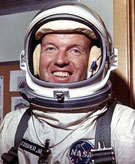
During the early planning stages of EPCOT Center, it was decided that a real-life astronaut be
hired as Vice President of Research and Development (after all a science-fiction writer named
Ray Bradbury was already onboard the project as well). Gordon Cooper, one of the original 7 U.S.
astronauts, served from January 1973 to 1975, as Vice President for Research and Development/EPCOT for
Walter E. Disney Enterprises, Inc. During that time he also lent his expertise to a new
attraction called Space Mountain. Gordon along with the other five surviving astronauts
astronauts selected by NASA back in April 1966, he also served as a member of the astronaut support crew for Apollo 10 and as backup lunar module pilot for the Apollo 12 flight. All these years later, Space Mountain continues to be a popular attraction and has grown to have universal appeal - versions were added to Tokyo Disneyland in 1983, Disneyland Paris in 1995, and Hong Kong Disneyland in 2005.
This Day in Disney History - THE FIRST - THE ORIGINAL
Traveling in time since 1999!
