
 | ||||||
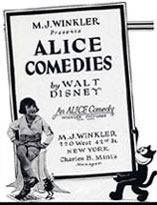
Disney's Alice Comedies were a series of short films released during the 1920s.
They featured Alice (a live-action girl) and Julius (an animated cat who resembled
Felix the Cat) in a cartoon world.Walt Disney's previous Laugh-O-Gram animated series -
produced in Kansas City - had been popular but financially unsuccessful.
(Laugh-O-Grams filed for bankruptcy in May 1923.)
In order to rise above his debts, Walt was forced to seek outside
projects. One of these projects was a dental hygiene film titled Tommy Tucker's Tooth
(produced for a Kansas City dentist). Walt used the $500 he earned from this dental short to
produce a film called Alice's Wonderland (a half-finished Laugh-O-Gram project).
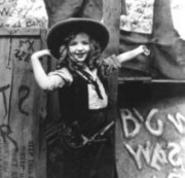



DISNEY'S ALICE COMEDIES
Before there was Mickey Mouse and Snow White,
there was Alice.



"Alice, you're the greatest!"


| ||||||
| ||||||
| ||||||

THIS SITE MADE
IN THE
USA
1923:
Alice's Wonderland
(never released theatrically)
1924:
Alice's Day at Sea (3/01/24)
Alice's Spooky Adventure (4/01/24)
Alice's Wild West Show (5/01/24)
Alice's Fishy Story (6/01/24)
Alice and the Dog Catcher (7/01/24)
Alice the Peacemaker (8/01/24)
Alice Gets in Dutch (11/01/24)
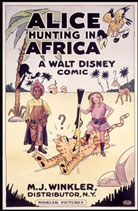
Alice Hunting in Africa (11/15/24)
Alice and the Three Bears (12/01/24)
Alice the Piper (12/15/24)
1925:
Alice Cans the Cannibals (1/01/25)
Alice the Toreador (1/15/25)
Alice Gets Stung (2/01/25)
Alice Solves the Puzzle (2/15/25)
Alice's Egg Plant (5/17/25)
Alice Loses Out (date unknown)
Alice is Stage Struck (6/23/25)
Alice Wins the Derby (7/12/25)
Alice Picks the Champ (date unknown)
Alice the Jail Bird (9/15/25)
Alice's Tin Pony (9/20/25)
Alice Chops the Suey (9/25/25)
Alice Plays Cupid (10/15/25)
Alice Rattled By Rats (11/15/25)
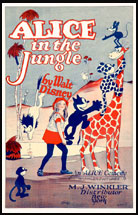
Alice in the Jungle (12/15/25)
1926:
Alice On The Farm (1/01/26)
Alice's Balloon Race (2/15/26)
Alice's Orphan
Alice's Little Parade
Alice's Mysterious Mystery
Alice Charms the Fish
Alice's Monkey Buisness
Alice in the Wooly West
Alice the Fire Fighter
Alice Cuts the Ice
Alice Helps The Romance
Alice's Spanish Guitar
Alice's Brown Derby
Alice The Lumber Jack
1927:
Alice The Golf Bug
Alice Foils The Pirates
Alice At The Carnival
Alice's Rodeo
Alice The Collegiate
Alice In The Alps
Alice's Auto Race
Alice's Circus Daze
Alice's Knaughty Knight
Alice's Three Bad Eggs
Alice's Picnic
Alice's Channel Swim
Alice In The Klondike
Alice's Medicine Show
Alice The Whaler
Alice The Beach Nut
Alice In The Big League


Walt enlisted a young Kansas City actress named Virginia Davis and put all his effort
into the new film. Alice's Wonderland, a silent black & white film
combining live-action and animation, was never released theatrically. But it did serve
a purpose ... it was shown privately to cartoon distributors in 1923.
One of these distributors was Margaret J. Winkler, a woman from New York who had been successfully distributing Felix the Cat. Walt (now living in California) signed with
M. J. Winkler on October 16, 1923 (this date became the formal beginning of
The Walt Disney Company). Walt and his brother Roy enthusiastically immersed themselves
into producing the first batch of Alice Comedies.
The Disney Brothers Studio was set up in a garage on Kingswell Ave. in Hollywood,
California. As they had no staff to help produce the first six shorts, Walt animated
the films all by himself and Roy worked the camera for the live-action sequences.
There were no rehearsals for the live-action filming and usually no more than
a single take was shot as the Disneys didn't always have enough film to reshoot!
The first, Alice's Day at Sea was released on March 1, 1924.
Fifty-six Alice Comedies were produced between 1923 and 1927. By the time Alice the Peacemaker was in production in 1924, Disney had built a studio staff that now included animators Ub Iwerks and Rollin "Ham" Hamilton, and camera operator Harry Forbes.
Over the years 4 different young actresses - Virginia Davis, Dawn O'Day,
Margie Gay, and Lois Hardwick - portrayed Alice.
Virginia Davis, from Kansas City, first began working for Walt when she was just 6-years-old.
She appeared in the first 13 titles of the Alice Comedies. (Davis later did voice
testing for Snow White as well as some of the little boys' voices in Pinocchio.)
She became a Disney Legend in 1998.
Dawn O'Day - whose birth name was Dawn Evelyn Paris - only played Alice in the
1925 release Alice's Eggplant. As an adult actress she appeared in over 30 features
under the name Anne Shirley. (She is the mother of actress Julie Payne.)
Margie Gay appeared as Alice from February, 1925 to December, 1926. Unlike the
others, Margie had a short, straight black hairstyle with bangs over her forehead.
When she left, Walt hired Lois Hardwick to play the part of Alice.
(She went on to become the first wife of actor Donald Sutherland.)
The final Alice Comedy Alice in the Big League was released in Summer 1927. At this point Disney's staff also included Les Clark (who would become one of Walt's "Nine Old Men")
and Hugh Harman & Rudolf Ising (the duo who would become famous for starting the
Warner Bros. and Metro-Goldwyn-Mayer animation studios).
Walt and Roy enjoyed moderate success with these shorts, thus
enabling them to set-up a larger studio on Hyperion Avenue in
February 1926. Alice Comedies proved to be a major stepping stone
in Walt and Roy's career.
"It was very informal. We used to have a lot of people gathered around. During the silent days we would have a lot of the curious children and the neighbors come around to watch what was going on. They would use some of the children in some of the scenes as they did in one of my favorites, Alice's Wild West Show (1924), where they were used as the audience. There was no Screen Actors Guild so there was no place to go if you needed somebody for a film. You just used whomever was around at the time." -Virginia Davis on filming
"Gini was a very special lady who always took great pride in the historic role she played in our studio's
history. In fact, she liked to remind everyone that it all started with Alice, not Mickey Mouse."
-Roy E. Disney on Disney Legend Virginia Davis
Alice Comedies
This Day in Disney History - THE FIRST - THE ORIGINAL
Traveling in time since 1999!
